-
Talent: Lana Condor @lanacondor
Words: Daniel Anderson @danzstan
Photos: Ken Medilo @kenmedilophoto
Fashion: Estelle Aporongao @estella.png
Makeup: Melissa Hernandez @melissa.hernandez
Hair: Kat Thompson @kattthompson
Photo Assist: Joshua Medilo @joshua_w_mccoy
Video: Dalton Belew @daltonbelew
Lana Condor is exactly who I expected her to be, with a few surprises tucked in.
I have wanted to interview her for a long time. There were the obvious reasons. We are both Asian adoptees raised in Washington state by white parents with comically basic white-people names: hers are Mary and Bob; mine are Pam and Tom. We both grew up with one other Asian adoptee sibling. And, judging by the food she posts on Instagram, we possess an almost dish-for-dish congruent palate. Condor has said that she needs to eat noodles every day; without them, she feels "unbalanced." When I told her I understood completely because I am the same way, she lit up. "Every single day," she insisted. "And it's not a lie. It's my biggest truth." After our interview, I saw on Instagram that she had made pasta vongole, a favorite of mine—and one I had made myself only a month earlier.
The similarities kept accruing once we started talking. We are both deeply introverted people working in professions that require us, with some regularity, to pretend otherwise. I told her that people assume interviewing celebrities, attending premieres and working red carpets must mean I am naturally outgoing. She knows the feeling. "I'm an introvert that had to learn because of her work to present as an extrovert," Condor explained. "I charge fully and completely by myself. I don't know how to charge any other way."
When she made her film debut in 2016 with X-Men: Apocalypse, she remembered watching the accomplished women around her and assuming that eventually she would become more settled, less awkward, more at ease with all of it. Instead, nearly a decade in, she told me, "I think I feel even more introverted, far more introverted than I did before I started this career."
I first discovered Condor with that debut. I remember watching every press junket interview I could find, mostly because I couldn't quite believe that there was another Asian adoptee from Washington state sitting there talking about joining a superhero franchise I loved. Then I saw the movie and realized that most of what she had filmed was gone. I was pissed. I was sad. It was one of those small disappointments that, over time, ignited part of a much larger desire in me to seek out Asian stories in film and television and give them the attention I wished they had always been given.
So perhaps I had built this interview up too much in my head.
The night before we spoke, a sudden wave of anxiety dogged me through dinner—short-rib ragù pasta from Due' Cucina in Seattle, then Salt & Straw vanilla ice cream—and somehow remained the next day as I prepared Costco hamachi poke, dressing up the rice with lemon olive oil. This is, objectively, too much information about what I ate before interviewing Lana Condor, except that within minutes of getting on the phone with her, we were discussing exactly that.
She was openly dubious of my Costco poke. "Is it good?" she asked, with enough suspicion that I briefly felt compelled to defend it. Soon we were swapping Seattle food recommendations and comparing our daily noodle habits. This was the Lana Condor I had expected: jovial and disarmingly easy to talk to. What I hadn't expected was how candid she would be when I asked my first real question.
I wanted to know whether her recent string of action-heavy films—Valiant One, Pretty Lethal and now The Devil's Mouth—was, in some way, an attempt to attenuate the romcom image that has followed her since To All the Boys I've Loved Before made her a star.

"How do I say this?" she began, then carefully paused. "I never ever want to sound ungrateful." It is a qualification she returned to more than once, as though even acknowledging the ambivalent afterlife of To All the Boys risked diminishing what it gave her.
And it gave her a lot. Based on Jenny Han's bestselling YA novel, To All the Boys I've Loved Before made Condor—ensorcelling as the guileless, diary-keeping Lara Jean—one of the defining faces of Netflix's romcom resurgence and, at the time, she was described as the first Asian American actress to lead a YA romcom.
The movie became a phenomenon. Netflix later said the To All the Boys films had reached more than 125 million households, and what began as one adaptation became a full trilogy. Even after Lara Jean's story ended, the world kept going: her younger sister Kitty got her own Netflix spin-off, XO, Kitty, set in the same universe.
And still, there is a question that lingers beneath all that gratitude: "God, will any of my work ever be received that way again?"
Success that large and that early can become its own kind of polaroid. "I do think there is an element where people can freeze you in time a little bit in their minds," Condor observed. She was 21 when the first To All the Boys arrived. Eight years have passed. "I'm older, and I'm different, and so are my fans."
The industry, she has found, does not always move forward at the same pace. "Sometimes you're a little bit frozen in that space, and people forget that you age." It is not a complaint unique to her, she stresses, but something she has watched happen to friends who found success young: one role works so well that it becomes difficult for people to envision you beyond it.
That does not mean Condor thinks the work itself was easy. If anything, she wishes people grasped how difficult it was. "With romcoms, people think they're so easy to make," she noted, "because they're easy to watch." Two people meet, frolic around, kiss, the credits roll. Making an audience care is another matter. "Having an audience fall in love with you is an almost impossible feat," she continued. "It's really hard to earn someone's care for you."
Lara Jean may have seemed effortless; Condor asserted that effortlessness was part of the work. "I would love it if it was just me being cute," she said. "But I'm a little psycho at home. I'm not adorable like Lara Jean." She loves the character—"I want to be her best friend"—but even Jenny Han, she added, has always been quick to draw the distinction: Lana is not Lara Jean.
This is the tension fueling much of what Condor makes now: how do you build a second act when the first one loved you so specifically, so completely, for someone you were never quite like to begin with? Her answer, it turned out, was to go back to where she started. "Was I wanting to show that I could do more? A hundred percent," she acknowledged. "But was it also genuinely just a desire to go back to my roots? That's also true. It might seem random to people watching from the outside, but my parlay back into thrillers made a lot of sense to me, because that was just my past."
The Devil's Mouth may bring Condor back to those roots, but it also asked her to do things she had never done before. On the surface, it is pulpy shark horror by way of what looks like a lovely getaway in Thailand. Making it was considerably less idyllic. Much of Condor's work took place in or beneath the water where the ordinary mechanics of acting suddenly became technical exigencies—finding a mark, knowing where another performer was, marshaling her body and expression while submerged, and doing all of it while managing her breath. Some days meant spending 12 or 13 hours in the water. And there was one fairly significant complication.
"I hate that shit," Condor told me with fervor, half-laughing but entirely sincere. She meant the water. For someone raised in Seattle, a city surrounded by it, it is a funny aversion to have.
Condor knew this about herself when The Devil's Mouth first came her way five years ago. She read the script, saw what making it would require, and promptly passed. "I think I wrote back to my team, 'You would have to be insane to want to do this movie,'" she remembered.
Five years later, the script found its way back to her. The filmmakers still wanted to make it. They still wanted her. The water, presumably, had not grown any more inviting. Condor had simply changed her mind about the insanity required to say yes. "Well, now I'm a little bit insane," she remembered thinking. "Now the insanity has gotten to me, and now actually, I think I am ready to do something like this."
She credited being a Taurus—and the stubbornness that comes with it—for helping her persevere. "I'm a very stubborn, stubborn person," she emphasized. The Devil's Mouth became a challenge she wanted to set for herself: "I was like, 'Lana, can you do this?'" Mentally, she knew she was strong enough; physically, she wasn't so sure. But when doubt crept in, stubbornness took over: Keep going. It's not that hard. You do deserve to be here. You are the best.
Even when those affirmations felt fraudulent, she kept repeating them. "I don't want anything to break me," she declared. "I just kind of grit it out from a place of stubbornness. It's less that I'm like, 'Game,' and more that I'm just like, 'Fuck you. I'm sure I can do it.'"
And on the hardest days, the mantra became simpler and louder: "Okay, Lana, you hate this, but this is your job. You fucking got this. You're not a little bitch."
That stubbornness would serve Condor well on her other project, though in this case the fight continued long after she had finished filming. Coyote vs. Acme, which finally reaches theaters August 28, has weathered extraordinary vicissitudes en route to the screen that feels perfectly suited to the movie itself. The live-action/animation hybrid turns one of the oldest jokes in the Looney Tunes universe into a David-and-Goliath story: After a lifetime of being blown up, flattened and otherwise maimed by malfunctioning ACME products in his pursuit of the Road Runner, Wile E. Coyote decides to sue the company that made them.
Will Forte plays Kevin Avery, a down-on-his-luck lawyer who takes Coyote's case; Condor plays his niece and new legal intern, Paige Avery, while John Cena represents the corporate giant on the other side.
The parallels between the movie and what happened to it became increasingly ineluctable. Despite being completed, Coyote vs. Acme was shelved by Warner Bros. in November 2023 as the company planned to take an estimated $30 million tax write-off rather than release it. The decision placed the film alongside Batgirl and Scoob! Holiday Haunt, two other Warner Bros. projects consigned to the vault, and for a time it appeared that a movie about a hapless underdog fighting an indifferent corporation might itself never see the light of day because of a corporate accounting decision.
What followed was an unusually concerted public campaign to keep it alive. The decision drew backlash from filmmakers, cast, and crew and eventually led Warner Bros. to allow the film to be shopped elsewhere, though its future remained uncertain for more than a year.
Then, in 2025, independent distributor Ketchup Entertainment acquired the film for roughly $50 million, rescuing it from the vault and setting it on the path toward its release.
The long delay has done little to dampen the response: the reviews amount to a critical encomium for Coyote vs. Acme, which, at the time of writing, sits at 97 percent on Rotten Tomatoes from 59 critics.
"I'm a very gut instinct person. I have followed my instincts—it's all I have," Condor reflected. "It's so easy to blame yourself when a movie does badly. My first thought was: it must be me. But this movie was different, because so much of it was CGI. You're in a green room with nothing around you except green, green, green, and it's up to your imagination, and then up to everyone else to help make sure whatever's in your mind's eye reads as something universal. You have no idea if it's going to be good or bad until you actually see it." She laughed, a little ruefully. "Maybe Wile E. was a bad actor. Maybe they animated it wrong. I don't know."
Then they held a "funeral" screening for the cast and crew after the news had already broken that it might never come out. "It was really good," she recalled. "And that was far worse. I was deeply hoping it was going to be bad, so I could tell myself it was a blessing that it wasn't coming out. It was categorically great. And I was like—‘Damn, that sucks.’"
What she comes back to, though, isn't the injustice of it. It's the way the people involved held together. "We all grieved together. We got angry together. We got elated together. Never once did anyone blame each other, and that's usually the first thing people in Hollywood do—point fingers. No one did,” she said. “Everyone was just heartbroken and confused, communally. As disheartening as it was, and as bad a precedent as it set, I felt so grateful to be part of it. If it had to happen to one of my films, I'm glad it happened to this one, because of the people. I don't think every production would have stayed as tight-knit and hopeful as we did. In a weird way, it gave me more hope, because at least I was going through it with cool people."

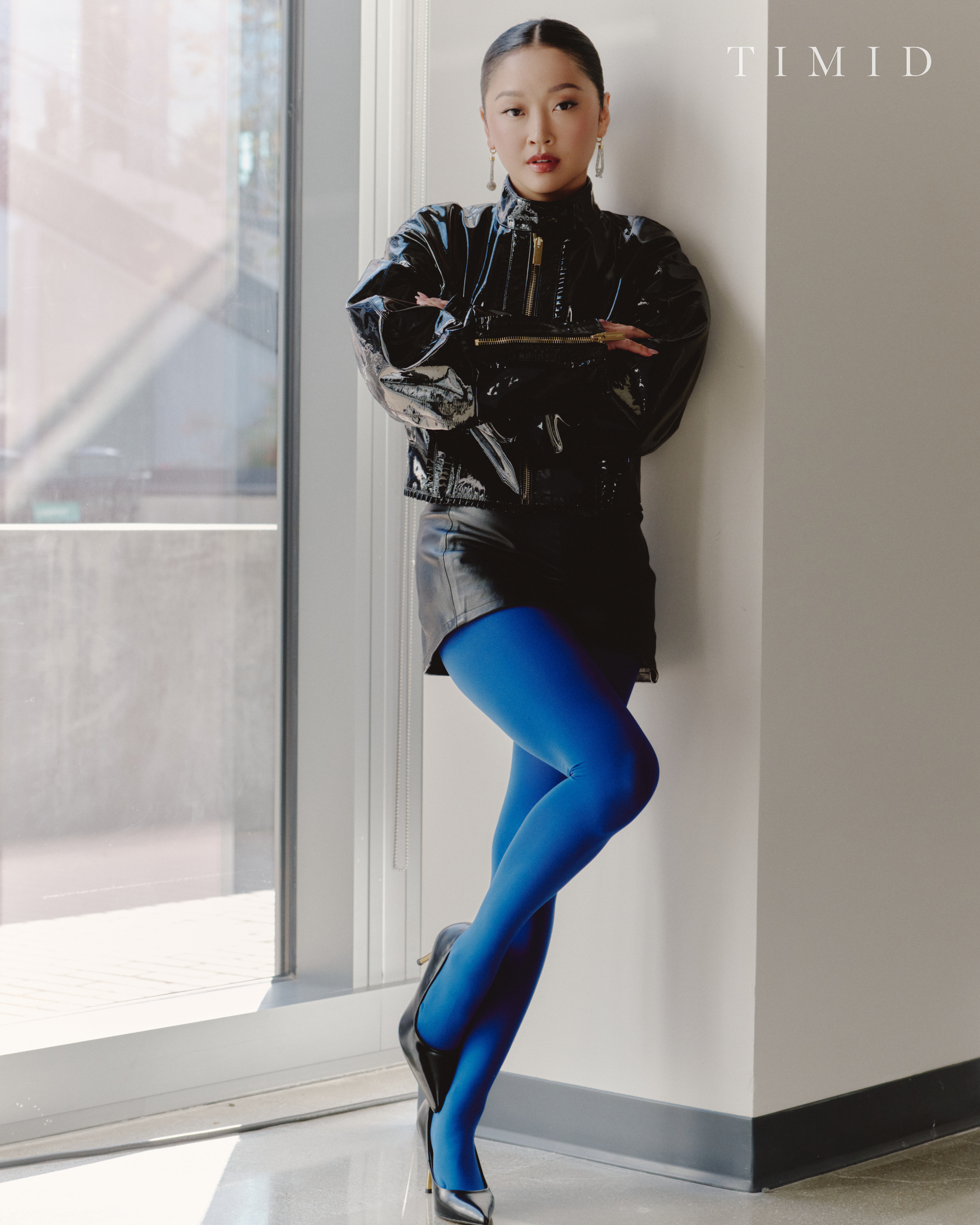
When I ask Condor what her personal Road Runner is—the thing she is still chasing—her answer arrives more haltingly. "Is it lame to say…" she started, before deciding to say it anyway. "I would love some critical success." Condor feels fortunate to have built a career in commercial films, but she has rarely had the chance to work in the indie world. She has never been to Sundance; this year's South by Southwest was her first film festival. "There are so many phenomenal filmmakers and writers and directors in that space I would love to work with," she said.
Her father raised her on the phrase "Greatness is coming," words that have stayed with her, though not always comfortably. "I think it's a double-edged sword," she admitted. "Sometimes when I feel like I do something great, I'm like, damn. Well, greatness is coming, so maybe this thing isn't so great."
She pondered aloud whether always believing something greater lies ahead might also mean never quite permitting herself to be satisfied with what she has already done. "Will I ever be happy because I'm always going to be chasing greatness?" she questioned.
And yet, almost in the same breath, that restlessness turns back into belief. "I believe I have a lot to offer as an actress," Condor stated. "Just give me a shot."
There is yearning in the kind of conversation she'd like to have about her work. Condor told me she watches interviews with actors where the questions pertain to craft: how a character was built, what preparation demanded, what it means to make art at that level. "I think people are curious about my work, but I don't know if people are curious about my art,” she wondered.
There is no bitterness in the admission, only an unvarnished vulnerability. She even catches herself humbly, saying perhaps she has not yet done the work to deserve those questions. But the hope underneath it is uncomplicated: "I'd like to be taken seriously."
Condor and her publicist were munificent with their time. As our conversation wound down toward the hour mark—far beyond the 20 minutes originally allotted, I finally asked the question I have been saving for years: Would she ever want to make a film about the adoptee experience? Her own story already has the contours of one.
She would. But the answer comes with an immediate recognition of how impossible that assignment might be. "Everyone has their own feelings about being adopted and their own story," she said. There is joy in those stories, but trauma too. The challenge is imagining something "universal enough for the Asian American adoptee story" while leaving room for the fact that no such universal experience really exists.
It is the same problem, she argued, with trying to limit the Asian American experience at all. "That's assuming that we all have the same fucking experience," Condor remarked. "That's insane."
If she ever does tell an adoptee story, she wants to do it only once—to make it the kind of project that belongs on the Mount Rushmore of her filmography. "I would love to," she said. "But it would have to be everything."
So, to all the Lanas audiences have loved before—the superhero, the romcom icon, the action star: know that the one standing here now is giving it everything she has. She is older, still stubborn, more introverted, perhaps a little more insane, and increasingly willing to chase the things that frighten her. She wants to make art people are curious about. She wants, as her father taught her, to believe that greatness is still coming.
Maybe that means never being entirely satisfied. Maybe it simply means staying hungry enough to keep reaching for something more.
With Condor, I've learned, it is best to expect the unexpected.
P.S. She gives a fantastic poke recommendation.