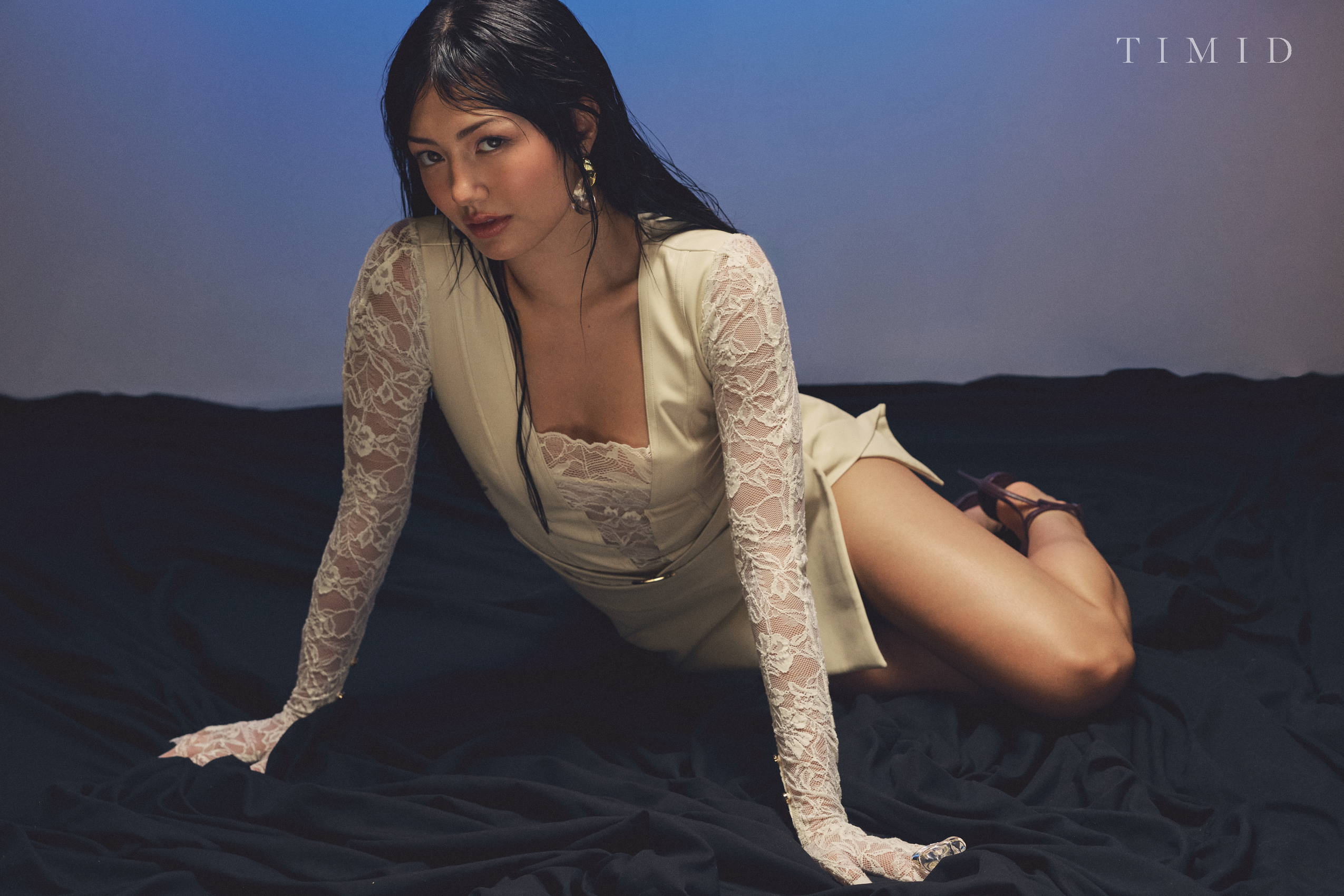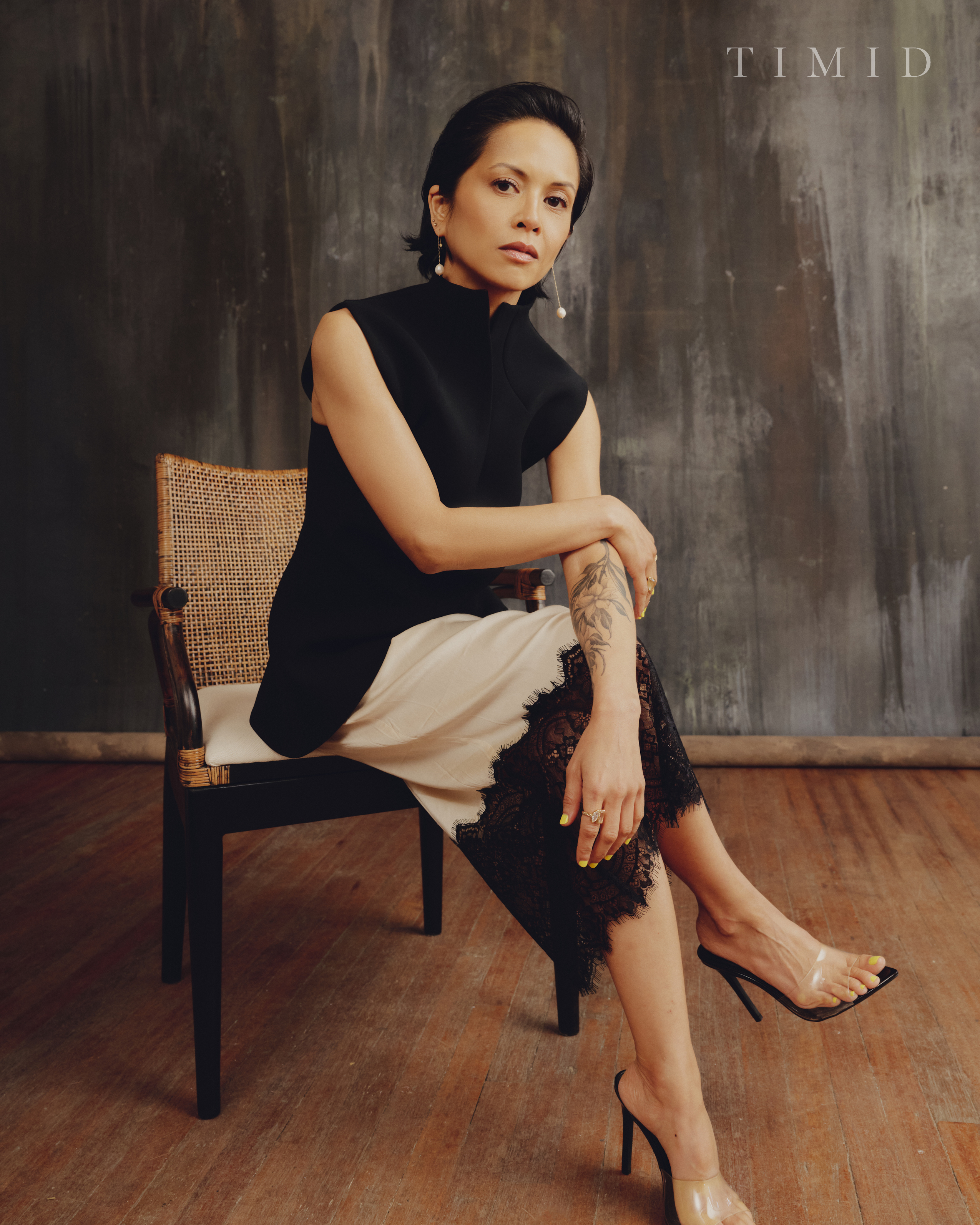
-
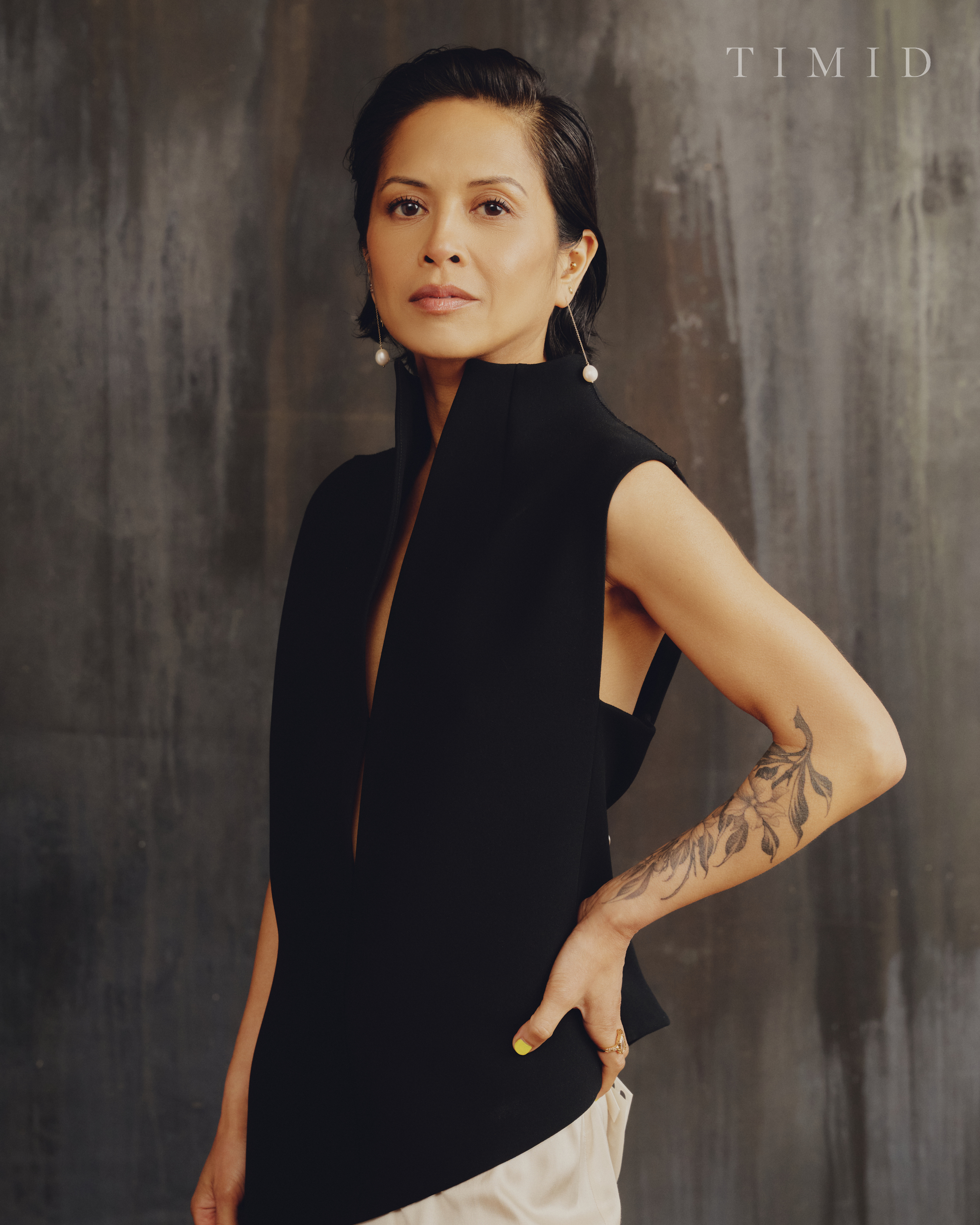
Talent: Amielynn Abellera @amielynn.abellera
Photos: Ken Medilo @kenmedilophoto
Fashion: Benjamin Holtrop @benjaminholtrop
Makeup: Robert Bryan @robertti
Hair: Ian James @ianjameshair
Photo Assist: Joshua Medilo @joshua_w_mccoy
Fashion Assist: Emily K.E. Johnson @emilykejohnson, Rasheed Kanbar @rasheedmkanbar
Video Jonathan Ho @_jonathan_ho
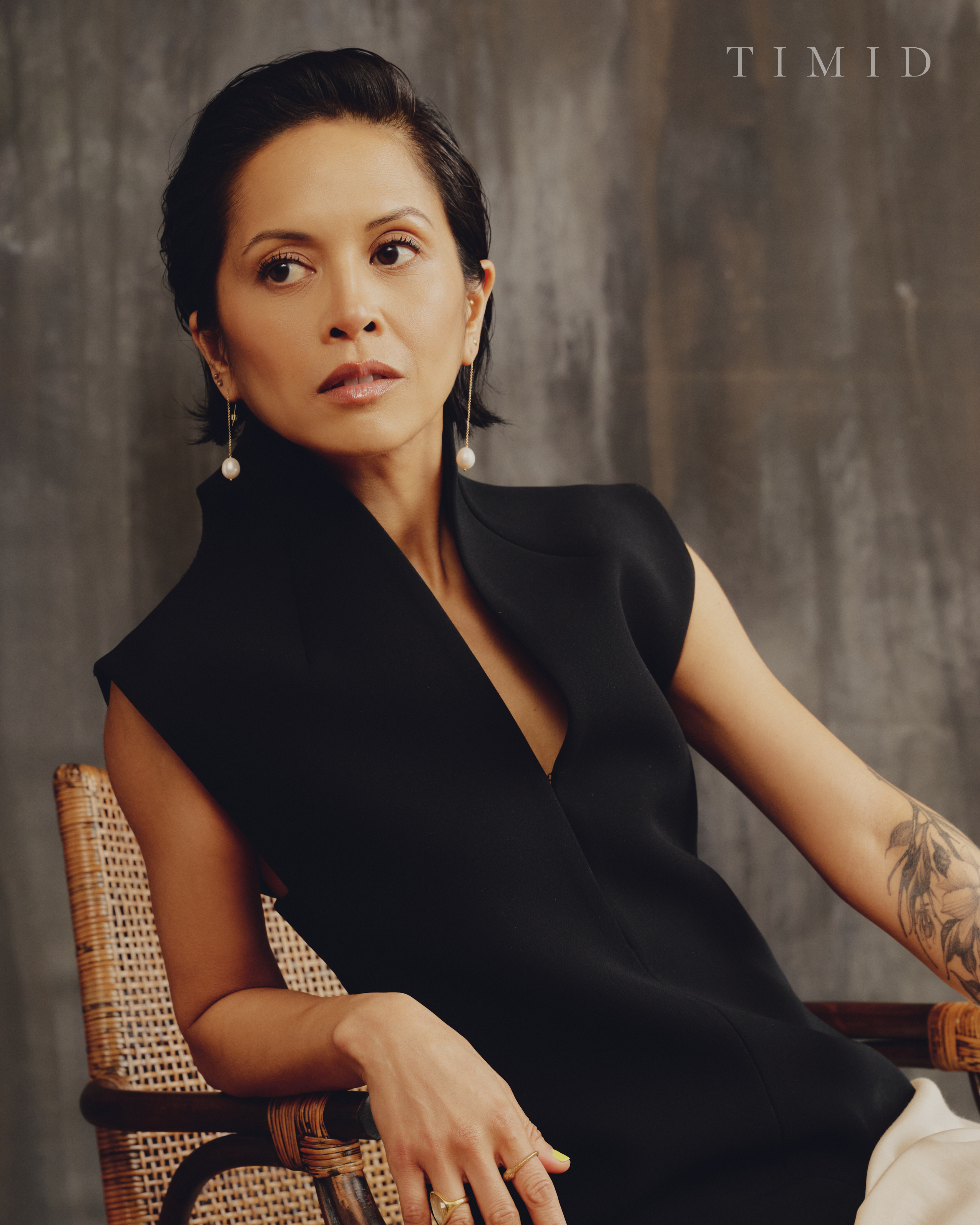
Amielynn Abellera is unfailingly gracious when she speaks. She thanks you for the question before answering it, then offers something considered and precise, as if each answer is something to be handled with care.
It makes perfect sense, then, that she inhabits Nurse Perlah Alawi on The Pitt with such natural tempo and steadiness. Before fully committing to acting, Abellera was on the pre-med track, studying psychobiology and seriously considering a career in medicine. You can feel it in Perlah, in the way she listens and the way she holds space. And in a profession where Filipino nurses make up a disproportionate and essential part of the workforce, Perlah’s presence expands that representation further still. As a Filipino Muslim nurse, the character carries a layered identity that is rarely depicted on screen, one Abellera approached with rigor, research, and close attention to how faith and function intersect in a hospital setting.
Amielynn Abellera: Has it sunk in? I don’t think so. I don’t think it ever really sinks in. I still can’t believe that the response has been so massive, and all the awards that the show has won. It’s overwhelmingly wonderful.
AA: That’s a great question. In terms of getting my MFA, for a long time I wasn’t pursuing acting vigorously. I was on the pre-med track, and I didn’t have formal training. Being a very linear, education-oriented person, I wanted the strongest foundation I could get, so I pursued an MFA after finishing my bachelor’s in psychobiology.
What was wonderful about the USC MFA Acting program is that it gave me a community. I was coming from Northern California, and the idea of jumping into the industry in Los Angeles felt overwhelming. I didn’t know what that meant or how to approach acting as a craft in a formal way.
The program took nine students in my year, and the faculty were working artists with substantial careers. They guided us in both craft and industry, allowing us to grow over three years, learn vulnerability, and fail in a safe space while exploring creativity unique to each of us. Before that, I had done theater in San Francisco and since I was a kid, but I never had a space where I could fully explore craft and fail while being supported.
What it couldn’t prepare me for is exactly that transition out of that safe space. You don’t really know how the world works until you’re in it. Real-world experience is essential and learning how your creativity fits into collaborative spaces. That took years. After graduating in 2011, I did a lot of theater and smaller TV roles, and learned things like what a call sheet is, how many takes you’ll do—those practical aspects you only learn on set.
AA: I learn so much from everyone. Each cast member brings a different personality, approach, and stage of experience. Some come from deep theater backgrounds, others from TV, and we all have to come together to create the same tone and environment.
In terms of someone I really watch and learn from, I’m inspired by Noah every day. He’s the star and executive producer, wears so many hats, and is the first one there and the last to leave. He carries the largest workload—lines, emotional depth—but is also incredibly kind, compassionate, and considerate. He takes time to talk to everyone: crew, background, actors.
That sets the tone for the entire set. We all operate from that same level of humanity, which carries into the work. It mirrors who Dr. Robby [Noah Wyle] is, too. I can’t imagine having a different kind of leader.
AA: You’re right. I did feel like I had to make a choice at one point. I thought maybe I could pursue medicine and still do theater, but that’s pretty much impossible. So this job feels like hitting the jackpot. I genuinely loved human biology and medicine. There’s something powerful about identifying a problem, applying knowledge, and helping someone while holding empathy. Even as an actress, I still approach my work that way.
I treat acting almost like a science. I learn lines very rigorously, then expand creatively from there. But you also have to let go and allow freedom in the moment. It’s that balance—laser focus, then creation. I think both of those. I love existing in that range. I'm so happy that I was able to experience the range of trying to pursue medicine, but then, letting myself be an artist and actually grow that range.
AA: A little bit of both. When I shifted from medicine to acting, I believed my parents weren’t supportive, but looking back, they really were. I think they just really wanted me to be happy, and any sort of pushback or questioning of that shift and transition was mostly because they didn't have the experience or know what questions to ask, or actually know how to support me.
I think I took that as criticism. But ever since I made that switch, they have come to every single show that I've been in, which is, dozens here in LA or, anywhere around the region of the theater. They're always really curious and interested to know how to connect with me in those sorts of ways.
My mom is a nurse practitioner and my dad is a family practitioner, so they didn’t always know how to connect to my work. But with this role, it felt like everything aligned.
It wasn’t pressure of I have to get this in order for them to accept me as a creative actress. It was more of just the joy and wonder of an ideal project for me to be able to bring to my parents. This was something they could connect to seamlessly and viscerally.

AA: Obviously, it is a wonderful thing to have these three Filipino characters on the show. For a long time, mass media didn’t have a ton of representation for Filipino and Filipino American experiences. There is something in the water now, a cultural shift where I feel like we are really making our way. There’s a curiosity about Filipinos and Filipino Americans in all spaces: TV, music, sports, cuisine, and style. It’s just really growing.
That was something that was not a part of my childhood. Reflecting on it now, I think that lack of representation had a challenging and negative impact on my growth and how I celebrated my heritage. There was nothing for me to look at, point to, and say: “Look, that’s me. That’s my mom. That’s my dad in these medical dramas.”
Quite frankly, it was confusing. In my world in Stockton, California, I would go to the hospital or the clinic with my parents and it was dripping with diversity. There were Filipinos and people speaking different languages everywhere. It is far more common to have that diversity and those multilingual healthcare workers than not. So, when I would watch TV, and I was obsessed with television, it was very jarring.
That also affected my growth as an actress. Because there weren’t many Filipinos on screen or in theaters, it made me hesitate quite a bit. I wondered if there was even a place for me in that world. So, I do feel there is a tectonic shift happening in media now where we are being seen and represented more, which is wonderful.
In terms of the Filipino Muslim character of Perlah, it is so exciting to see a single character able to embody numerous identities and dimensions of life—both Filipino and non-Filipino—that have been so absent in media. When I got the role, I was excited, but also initially very anxious. I felt a big responsibility to do it right, to be accurate, and basically just not 'fuck it up.'
That anxiety and fear propelled me into a deep dive of research during the two weeks I had before we started season one. I was able to find and talk to several different Filipino American Muslims online and hear their experiences. It was a major learning process. I initially wanted to know everything, thinking that was the best approach, but I eventually realized there was no way I could integrate the entire Islamic experience in just two weeks. I had to allow myself some grace. I realized the priority was understanding how someone’s religious background affects their nursing and how it influences them in the workplace. That was what I really needed to bring to the table.
AA: One person I spoke to shared that his wife, a nurse, found that wearing a hijab could sometimes be a physical barrier in the operating room—using a stethoscope quickly, fitting goggles properly, and concerns about sterility. I brought that to the team, and they incorporated it into Perlah’s costume by sewing small openings into her hijab so I could access tools more easily. That was really meaningful.
Beyond that, what I learned is that her faith doesn’t hinder her work. Perlah prioritizes saving lives above all else. That’s what defines her as a nurse.
-
This interview is one in a series with the ensemble cast of The Pitt.