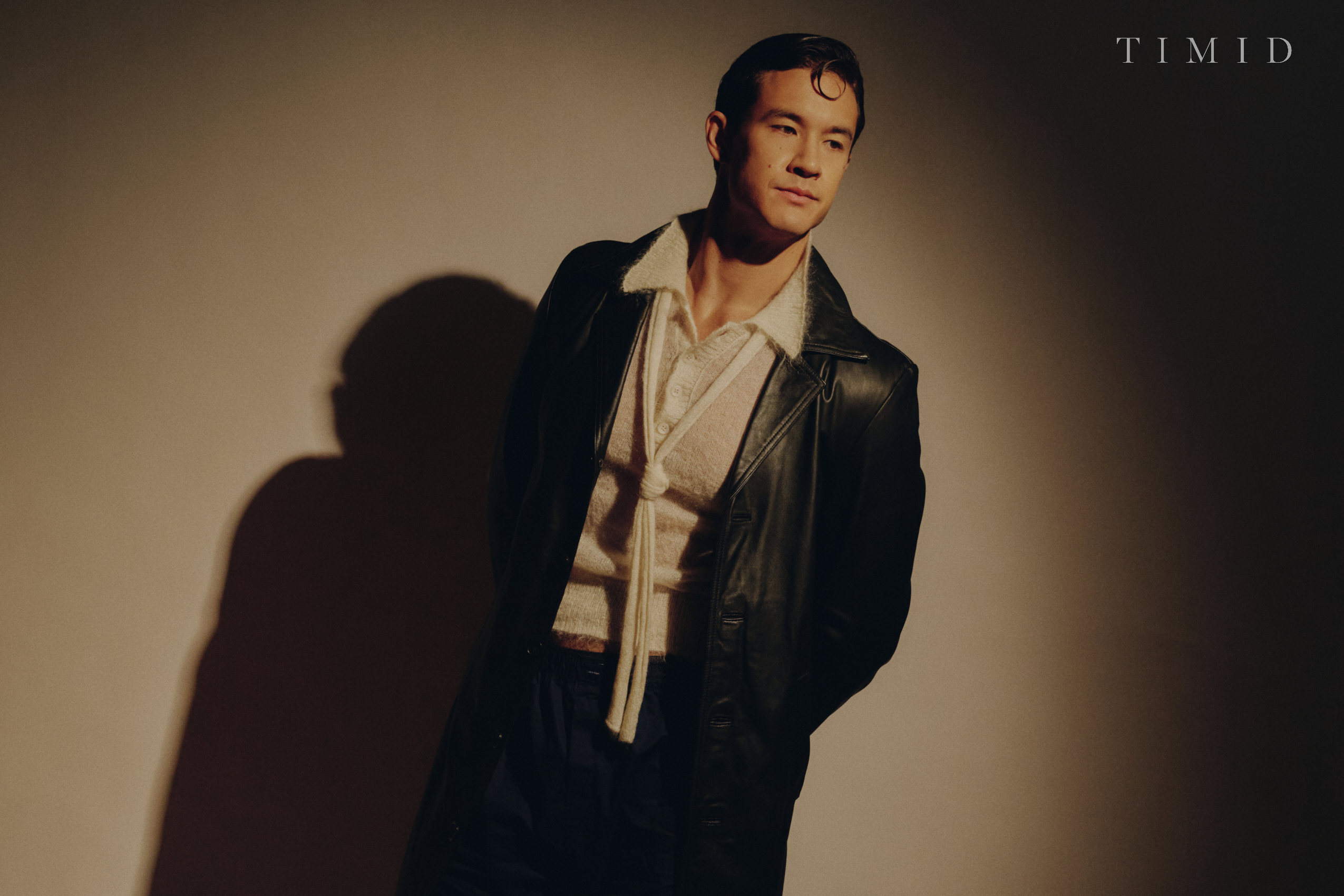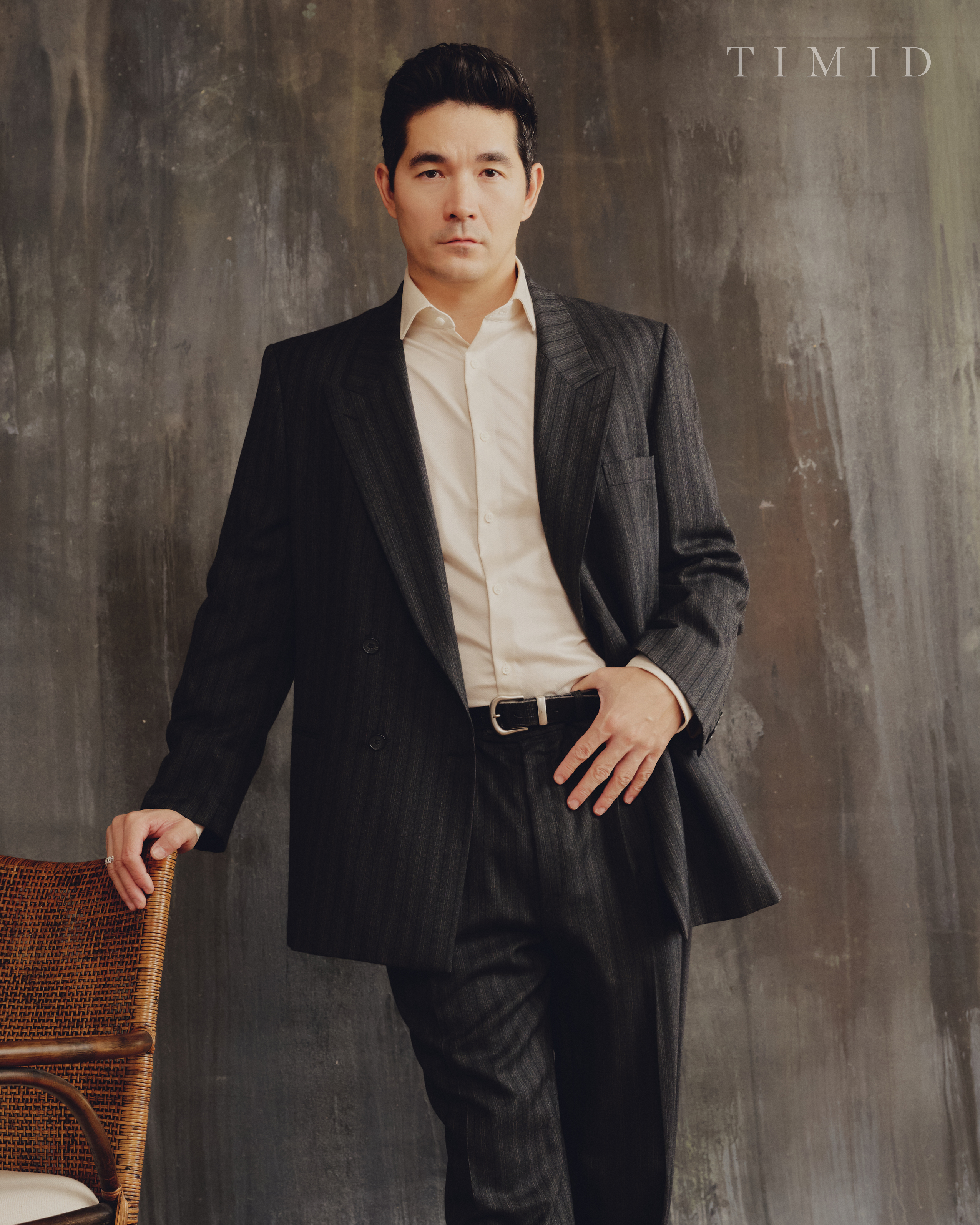
-
Talent: Ken Kirby @mrkenkirby
Photos: Ken Medilo @kenmedilophoto
Fashion: Benjamin Holtrop @benjaminholtrop
Hair & Skin: Jorge Buccio @bucciojb
Photo Assist: Joshua Medilo @joshua_w_mccoy
Fashion Assist: Emily K.E. Johnson @emilykejohnson, Rasheed Kanbar @rasheedmkanbar
Video Jonathan Ho @_jonathan_ho
There’s an easy and unforced cool to Ken Kirby. When we speak, he’s pacing lightly, occasionally stepping away mid-thought to tend to his dog, then slipping right back into conversation without missing a beat. At the start of the interview, I ask what I frame as a “very important question”—which city has the best Chinese food, given his upbringing between Vancouver, Hong Kong, Shanghai, and now Los Angeles. He happily launches into a five-minute answer, complete with regional breakdowns, specific dishes, and enthusiastic detours. It’s thoughtful and a little tangential, but entirely charming.
Born in Vancouver to a British father and Chinese mother, Kirby grew up across continents before eventually settling in Los Angeles. He initially studied business before finding his way to performance, later training at improv and sketch comedy institutions like the Upright Citizens Brigade and The Groundlings.
He now appears as Dr. John Shen on The Pitt. On screen, Dr. Shen often has a coffee in hand and seems to be waiting to spring into action. It’s a performance that mirrors Kirby’s own demeanor: nonchalant but precise, relaxed yet fully locked in when it matters.
Ken Kirby: That training was instrumental in helping me step into the show and fit in seamlessly, especially since I joined in Episode 12 during the mass casualty episode, which is arguably the most chaotic.
On my first day, I think I hit something like 20,000 steps—we were constantly moving, triaging patients. There’s an improvisational element because there are no standard marks. It’s almost like a stage play. You rehearse, then perform, and the cameras capture it.
That improv and stage training really helped. Things don’t always go as planned. Every take is different, so you have to adjust on the fly. That “yes, and” mindset is crucial—reacting naturally, adding things like dialogue or physical reactions when it feels right. The show allows for that flexibility because it makes the scenes more realistic. People wouldn’t be moving through a crisis in silence or waiting for cues. Sometimes things happen earlier or later, and you just adapt.
I think that’s why they cast a lot of actors with theater backgrounds. People like Patrick Ball, Lucas Iverson, and Isa Briones all bring that stage experience, which really translates well to this kind of production.


KK: Noah, for sure. The way he carries himself—he’s incredibly giving to everyone, from background actors to crew. If you have a question, he’s open.
You absorb a lot just by watching. I worked with actors like Shawn Hatosy, and they’re all very focused on the work. I remember feeling lost in a scene, and Noah said, “It’s all about the patient. Don’t worry about the camera. What would the doctor be doing? How would you be moving? Where would you be going? What would you be doing next?”
We also have incredible medical consultants. Joe Sachs is a wealth of knowledge. He shared real audio from doctors who responded to the Las Vegas shooting, which inspired parts of the show. There was a smaller hospital that got overwhelmed because it was closest to the scene, and that informed how we approached those sequences.
We also have doctors and nurses on set constantly. If you have questions, there’s always someone who can explain what you’re doing and why. It’s like a crash course in medicine.
KK: When I got the role, there was a friend of mine, Matt, who works in an emergency night shift. He's very dry and very sarcastic. I know just from his demeanor that he's probably seen some shit, but he doesn't let it come out; he doesn't carry it with him. He uses humor as a way to deflect. In real life, I can relate to that. If something is tense or people are being overly serious, I use comedy to break the tension so everyone can have a laugh, relax a little bit, and take a breath. It happens even in the darkest of times. I think that was what I wanted to take into this role.
I’ve been really surprised by the character. I feel like it was a choice to be calm, dry, and sarcastic, almost excited by this stuff. You’ve been training and you go to school, but then you actually get into the action. It’s like signing up for the military but never getting to go to war. For Shen, when this mass casualty happens, he’s ready to go and almost excited about it. At the same time, he’s wondering if he can have Thanksgiving off. He’s just living his life; he’s not letting the highs get too high or the lows get too low.
A lot of doctors have come up to me and said, “You’re exactly like a bunch of our guys.” Night shift is a little weirder and a little wilder. They are sometimes odd cats. They are all foul-mouthed. My friend was telling me that a lot of them have a hard time transitioning to other departments after the ER because they are used to such language, a lot of swearing just to cut the tension.
Personally, you go through things in life. I wanted to carry some of that into the performance. You realize that in those situations, if you are the calm force throughout it, people can get better. Especially with a teaching hospital and a lot of younger doctors, if everyone is running around like a chicken with their head cut off, you aren’t going to help by adding that energy to it. If you can just go about your job and make it about the job, it doesn’t have to be anything more.
Some people unwind like Dr. Robby [Noah Wyle], you’ve got to cry in the corner. Some people have to talk to a therapist. Shen maybe goes home and plays GTA for a couple of hours. That’s the truth; everyone has their thing to help them unwind. For me, and for Shen, I don't play that many video games, but I always imagine he likes to go home and game, maybe hop on Twitch for a couple of hours to live cast and catch up with some friends online, and then dive back into it.

KK: I feel really proud. I think it’s an incredibly realistic show. Because they wanted it to be the most accurate medical drama of all time, you have to look at what these hospitals actually look like in the US. The truth is Asian Americans represent a huge portion of the healthcare system in the US.
I actually took a little screenshot of all seven of us from the photoshoot while I was at the wrap party and showed it to Noah. I said, “Look at this, Timid Magazine is doing this thing.” He thought it was so cool. He told me that when they were making the show, there wasn't a mandate for them. A lot of networks and shows have mandates where there has to be a specific checklist: two Black actors, one Latino actor, two Asian actors, and so on. I think it was even called a Minority Report—someone told me that for every TV episode, if your main cast is five white people, your guest stars and background actors have to fill a minority checklist.
He said there was no such mandate here. It could have gone down a very stereotypical route like things did back in the day, but because they wanted to be accurate first and foremost, it naturally led to this diverse cast. They realized this is an accurate representation of the healthcare system. If we aren't being truthful to that, then it doesn't matter if we’re truthful with the operations and the medicine. We have to be truthful with the humans and the characters that make up this place.
I’m very proud. When I first auditioned for the role, I believe the character’s last name was Tanaka. Ten years ago—and I’ve done shows before where I booked a role with a different Asian background; I’m Chinese-British, they wouldn't have even bothered to ask or change anything. They would just say, It’ll work, because, in quotations, we all have a similar vibe.
But on this show, I arrived and they had already done the research. It was Dr. John Shen. When I arrived for wardrobe on the first day, it was appropriated to my actual background, which was cool. I really respect that.
-
This interview is one in a series with the ensemble cast of The Pitt.