-
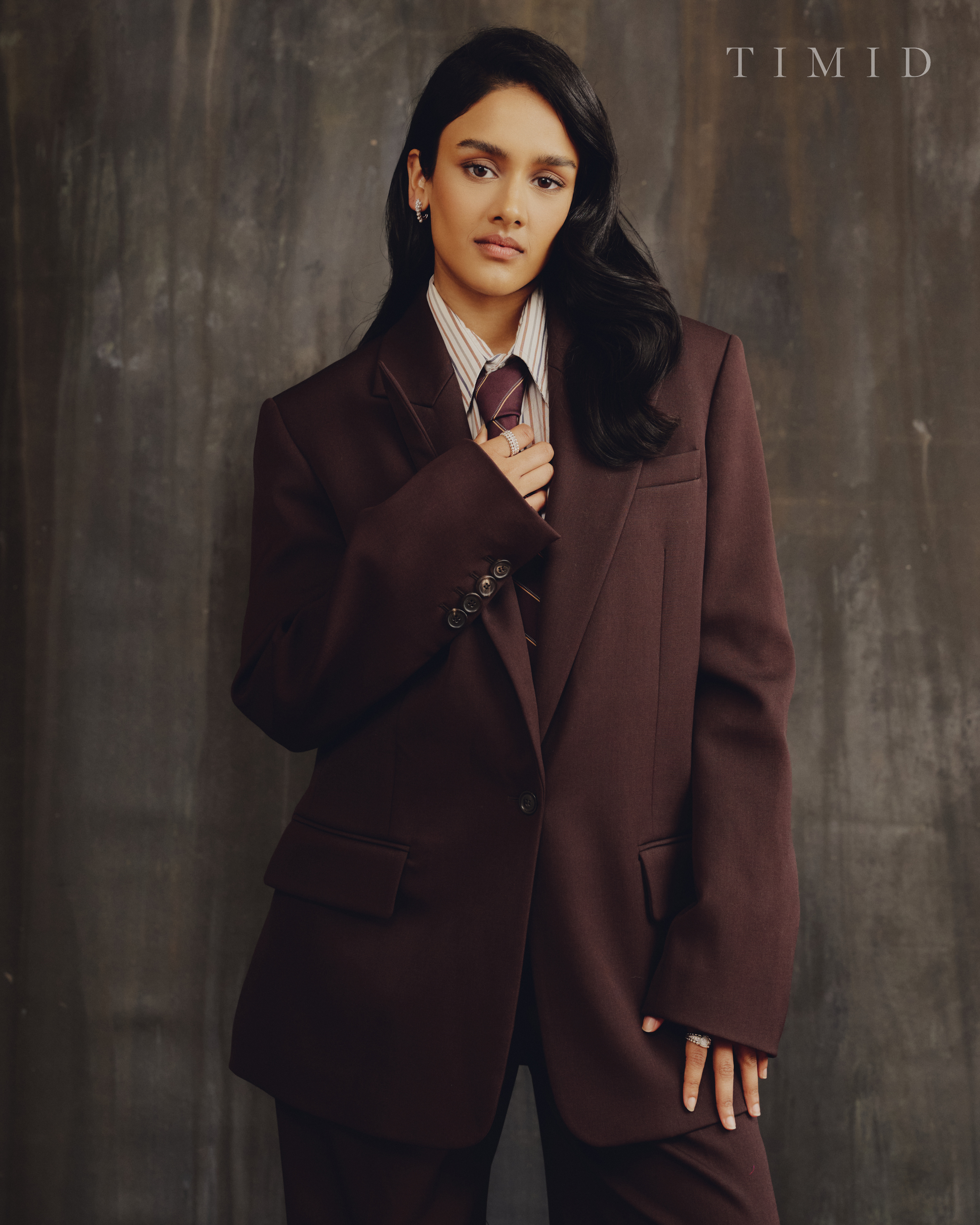
Talent: Shabana Azeez @shabanaazeez_
Photos: Ken Medilo @kenmedilophoto
Fashion: Benjamin Holtrop @benjaminholtrop
Makeup: Kym Nicole @kymmyizabeauty
Hair: Sharif Poston @sharifposton
Photo Assist: Joshua Medilo @joshua_w_mccoy
Fashion Assist: Emily K.E. Johnson @emilykejohnson, Rasheed Kanbar @rasheedmkanbar
Video Jonathan Ho @_jonathan_ho
Shabana Azeez clocks my video background immediately. It is a high-res still of the Hub, the high-octane nerve center of The Pitt. She zeroes in on the names listed on the digital whiteboard as if she’s still on shift, not an actor logging on from her trailer.
“Whitaker’s name was all over that thing!” she exclaims with a playful glint in her eyes. “It’s slander this season! They go, ‘No meds. You’re still a med student. Your name can’t be on it.’ Meanwhile, James has his name up there. It’s like someone is out to get me!” Before I can even respond, she asks to snap a photo of the screen—two quick clicks. “Legend!”
Her energy is springy, infectious, and disarmingly chaotic in the best way. It’s a jitteriness that perfectly mirrors her character, Victoria Javadi: a prodigious medical student handling high-stakes patients in a Level 1 trauma center. She is smart and driven, yet still navigating the invisible ceiling of being a student in a system that demands—and takes—everything.
This is a definitive breakout role for Azeez. Born in Australia to Indo-Fijian parents, she built a dynamic career across film, television, and live comedy before landing on The Pitt. In this role, everything clicks.
Javadi represents a necessary next generation; one that possesses the digital fluency and academic brilliance of fast moving times, but keeps its heart firmly anchored in empathy. In a system often defined by burnout and bureaucracy, Azeez portrays a character who offers genuine hope: a doctor-in-the-making with the determination to ensure that her soul and studiousness makes a real, human difference.
Shabana Azeez: I’ve shadowed too many people to mention all of them. All the actors have become mentors to me in different ways. Kristin, particularly. I didn’t train as an actor, I didn’t go to drama school, but she did, and she’s been taking me to plays. She and her husband took me to see Eureka Day. She gave me four plays, four deep cuts, and she’s basically doing theater school for me. She’s teaching me about American theater, which is very new to me. She gave me a bunch of really great plays and had Post-it notes on them explaining why she thought they were significant parts of American theater history.
And then Lucas, who plays James Ogilvie. He went to Yale, which he never talks about, but I act like he talks about because I think it’s funny. He’s been doing little clown things with me because I really want to learn but I’ve never trained. It’s been really fun.
SA: I went back to Australia because I don’t live here—not that I live in Australia either, I don’t really live anywhere. I shadowed a lot. I talked to a bunch of med students and doctors. They were really generous with me. I went to trauma centers, looked in the waiting rooms, and I got really lucky because this season starts with my first scene being a life support simulation. And I actually, totally serendipitously, got to shadow a two-day advanced life support simulation training module at the University of Adelaide. There were two students I watched in particular. One of them I thought, “Oh, that’s who Victoria thinks she is.” And the other is who Victoria wishes she could be. The guy she wants to be like, it was such an education watching how he handled the politics, the dynamics, knowing or not knowing answers.
Now that Whitaker [Gerran Howell] is a first year resident doctor, Javadi is sort of the last med student representation standing from season one. I really wanted my performance to be targeted toward med students and their experiences, as opposed to healthcare workers. This is sort of my last season to explore what it means to be a med student. That was really informative for me. Med students for life.


It’s funny; I think the opposite happened for me. In season one, I wasn’t braggadocious, but I was just so stoked to be here—and I still am. But back then, nobody had seen the show yet; nobody had even heard of it. There was no pressure. The environment they set up here is so conducive to playing, trying new things, and having fun. Even though I was working in an American accent and felt like I didn’t always know what I was doing, I worked my ass off. I knew I was the right choice for the character, and I knew exactly what to do.
Then, in season two, it felt like 'Hollywood' invaded my life. That was actually way more work than any of the creative stuff because I came here specifically because I want to act. Suddenly, I’m being thrown into photoshoots, which is so fun, and thank you for having me, but it’s scary. It’s not my primary skill set.
Weirdly, Shabana’s life got louder this season. In season one, she was almost completely silent; I was in beta. But this season, the other actors have truly helped me find my voice. Kristin, Amielynn, Supriya, and especially Isa have been so helpful. Isa will tell me, “You know, you can just ask for that.”
Even with Noah, he’ll see that I have an idea I’m not sharing, and he’ll come up to me and say, “What do you want to say? What’s your idea? Tell me.” That kind of kindness from the people around you is really where I think confidence comes from.
SA: This sounds insane, but nobody can tell that you're funny in a photograph. It shits me, because I think 80% of my personality is just wanting to make people laugh. Especially in a social situation or a conversation, I feel like I’m a good talker.
I think so much of performance is empathy. That’s what acting is: an exercise in empathy. It’s having empathy for your character and for the world they inhabit; it’s truly putting yourself in someone else's shoes. It makes you a more empathetic person by nature.
Then, Hollywood asks you to put a bunch of walls up to protect yourself. It’s a really strange thing to balance both those realities—to go to work and be an 'open wound,' to be raw, and then to come out of work and put those guards back up to protect yourself from people thinking you’re ugly online or whatever. It hadn't quite occurred to me how much the job itself is antithetical to the culture of fame. They are so poorly matched.
SA: I think in season one, she was a recovering people pleaser. Any kid who is 'too impressive' too young usually has to work on that. For me, the shift has gone from wanting to please the doctors in season one to wanting to please the patients in season two, which feels like a very natural progression as you learn and grow.
In season one, we were seeing her first day along with three of the other characters, so she didn’t have opinions about anyone yet. This season, she’s coming in knowing exactly who she likes and exactly who she thinks is annoying or rude. She isn’t figuring out Santos anymore; she knows exactly what she’s dealing with.
I think that makes the less gentle parts of her personality come out. She’s a bit shorter and less patient this season. She knows how much work there is to do, and she realizes that a day at the hospital is a marathon, not a sprint.
SA: First of all, I don’t think Victoria is a gunner at all. I think Santos [Isa Briones] is a bit of a gunner, though. I love that you know what a gunner is. I actually learned that term at med school before I started The Pitt.
When I found out James was going to be a character, I thought, 'Oh my god, I’ve met like seven of you.' But I think there’s something really interesting about the freedom James gives her. Victoria has been a people-pleaser for so long—always listening to exactly what her mother says, trying to make everyone proud and happy, and constantly trying to placate people, predominantly those who are older than her. Since she’s the youngest person there by about half a decade, she usually feels that pressure.
But with James, she can’t stand him. She doesn't feel the need to impress him. Because of that, she can just act however she wants in the moment. She can be rude, brash, and unfiltered. There is a real freedom and lightness in that. I think she perversely enjoys it. It’s fun for her to watch him get knocked down a peg; it’s fun to win against him.
It is definitely not fun for her to lose to him, though. Lucas and I were actually talking about that after he watched the first two episodes. He said to me, “I swear I remember winning some of those arguments!” But Victoria does not let James have an inch. When you’ve spent your whole life catering to other people’s whims and being palatable, having the freedom to be yourself—and even the freedom to be icky—is really powerful.

SA: It’s really heartbreaking that her mother's love seems incumbent on her success; it feels conditional upon her excellence. When you just want to be loved, it’s incredibly painful to feel like you have to “perform” to earn it. By contrast, her father's love feels unconditional. It feels genuine and rooted in her actual character.
I think her mother very rarely asks Victoria questions or shows interest in who she really is. She doesn't seem to care what Victoria wants or needs because she thinks she knows better. That may be true, but Victoria is only twenty; she needs to figure out what she wants for herself and be allowed to make her own mistakes.
This is a specifically migrant story, and I’m grateful to be telling it in this context. Her parents moved across the world and left their cultural comforts behind to give her this life. I relate to that deeply. My parents moved from Fiji when they were quite young and worked incredibly hard to ensure I could be comfortable. When I turned around and said, “I’m going to be an actor,” they were like, “What?”—which is a very fair and valid reaction.
With her father, because she has performed at such unreasonable levels for so long, those expectations have become reasonable to both of them. So, while that love feels unconditional, it still feels tenuous and scary. Her mother's personality and her loud anxieties about Victoria’s future tend to cannibalize the dynamic between the three of them. Victoria only gets to be a softer version of herself when she is alone with her dad; when all three are together, it becomes all about the mother.
It’s an interesting thing—the idea that you don’t have to be perfect. Her parents disappoint her in many ways, and she will likely disappoint them in many ways, too. I just hope the love can remain even through that disappointment, though I don’t know if we’ve seen evidence of that with her mom yet.
SA: I’m really excited about the social media element of the show as the resident Gen Z doctor. There is something fascinating about how Victoria was socialized; she was an iPad kid, and beyond that, her formative years were spent during COVID. While she was in college and med school, the pandemic was rampant. Third spaces are disappearing, life is getting expensive, and it feels increasingly unsafe for kids to just go to a skate park without their parents.
Because she was socialized primarily online, you see how socially inept she can be in person. We saw a lot of that in season one with Mateo’s character, and also with her patients. Finding community online is such a vital part of the Gen Z experience, but it’s a double-edged sword. We need to create a society where people can go outside and meet in real life, because the loneliness rates among Gen Z are out of control; it’s an absolute epidemic.
I’m glad to be telling a story involving social media that isn't gendered or dismissive. Often, young women who are influencers are maligned by society and not taken seriously. We see those biases play out this season, and we’ll see how that eventually resolves. I’m grateful that the digital space is where Victoria has gained her confidence and found her community. She’s providing real value and helping people.
SA: Oh my god, it’s so huge. Back where I’m from in Australia, there are so many Indian doctors. Being on The Pitt and playing a fake doctor is as close as I’m ever going to get to my parents truly approving of my career choices.
There are also so many Filipino nurses in America; they are such a massive part of the healthcare industry here. To have this much Filipino and South Asian representation is so meaningful because it’s true. It's real. This show does a great job of ensuring our representation isn't tokenistic. Not every storyline revolves around the fact that we are people of color, yet we still get to explore those cultural specificities, like Victoria’s storyline with her mom. Anyone could have played that role, technically, but it has an extra layer of meaning because it’s me, and characters like Eileen Shamsie—names that really matter.
I’m so grateful to be working with these people. I grew up at a time when there weren't many women of color acting, especially in Australia. It was much harder to find monologues to audition for drama school. There were these massive biases at play regarding my ability to even access an acting career. Because of that, I often feel like I’m constantly 'playing catch-up' on a personal level. I wish I’d had singing lessons younger, or that I could play an instrument like Isa, or that I knew theater like Kristin. There were so many things I felt I didn’t have access to for cultural reasons. To have people in my life now who are helping me bridge that gap because they’ve done that work is so meaningful. It’s a beautiful place to be, and it's all because of them.
-
This interview is one in a series with the ensemble cast of The Pitt.